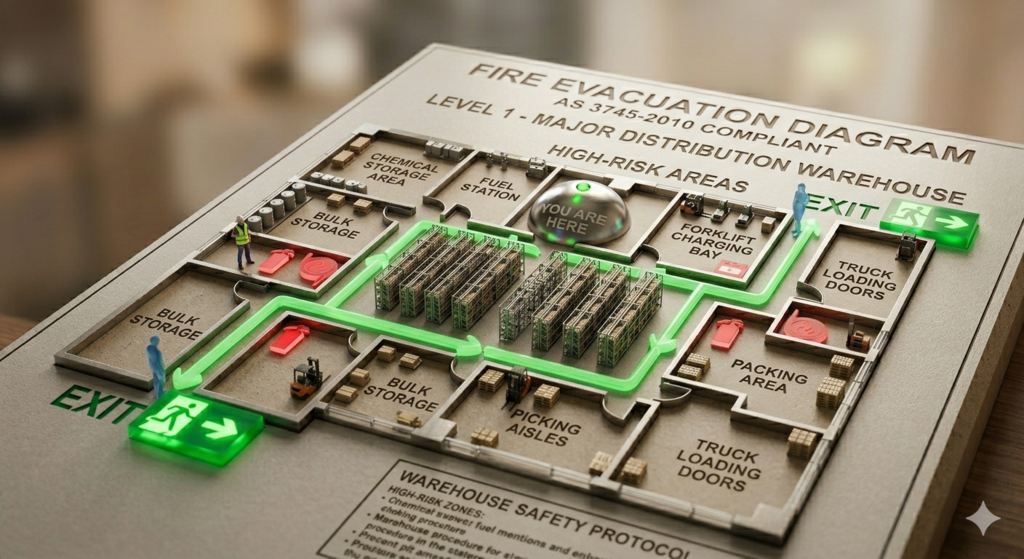
Warehouses are high-risk working environments that require specialised emergency planning to protect workers, contractors, visitors, and inventory during emergencies. Unlike standard office buildings, warehouses contain large storage areas, heavy machinery, forklift operations, loading docks, hazardous materials, and complex layouts that can make evacuations more difficult during dangerous situations.
This is why professionally prepared evacuation plans for warehouses are essential for workplace safety, emergency preparedness, and compliance with Australian safety standards. A clear and well-structured warehouse evacuation plan helps workers respond quickly during emergencies while reducing confusion, injuries, and operational risks.
Evacuation plans for warehouses are detailed emergency procedures designed to guide occupants safely out of the facility during emergencies such as fires, chemical spills, gas leaks, structural hazards, electrical faults, or machinery incidents.
Warehouse evacuation plans outline:
Because warehouses are often larger and more hazardous than typical commercial spaces, evacuation planning must be carefully tailored to the building layout and operational activities.
Warehouses present unique safety challenges that can complicate emergency evacuations. Large floor spaces, stacked inventory, moving machinery, and restricted visibility areas can make it difficult for workers to respond quickly if proper emergency planning is not in place.
Unlike office buildings, warehouses often include:
Because of these risks, evacuation plans for warehouses must provide clear instructions and highly visible evacuation procedures that workers can follow immediately during emergencies.
Warehouse emergency plans should prepare workers for a wide range of potential hazards. Some of the most common warehouse emergencies include:
A professional warehouse evacuation plan should include all essential emergency procedures required for safe evacuation and emergency response.
Evacuation diagrams are a critical part of evacuation plans for warehouses. During emergencies, warehouse workers need clear visual guidance to quickly locate exits, evacuation routes, and emergency equipment.
Warehouse evacuation diagrams typically display:
Professionally designed evacuation diagrams improve emergency response times and help workers evacuate more safely during high-pressure situations.
In Australia, warehouse emergency planning commonly follows AS 3745-2010, which outlines emergency planning procedures for workplaces and buildings. Businesses operating warehouses have a responsibility to maintain safe emergency procedures that protect workers and visitors.
Compliance may include:
Following proper warehouse evacuation planning helps businesses improve safety while meeting workplace health and safety obligations.
Warehouse environments change frequently due to inventory movement, operational changes, equipment upgrades, and storage reconfigurations. These changes can affect emergency access routes and evacuation procedures.
Warehouse evacuation plans should be reviewed and updated whenever:
Outdated evacuation plans can create confusion and increase risks during emergencies.
Even the best evacuation plans for warehouses require proper employee training to be effective. Warehouse staff must understand evacuation procedures and know how to respond quickly during emergencies.
Warehouse emergency training should include:
Regular emergency drills help workers become familiar with evacuation routes and improve overall emergency preparedness.
Professional warehouse evacuation planning services help businesses create effective emergency procedures tailored to their specific operational risks and building layouts.
Benefits include:
Experienced evacuation planning professionals can assess warehouse hazards, identify evacuation challenges, and develop emergency procedures that support both safety and compliance.
Evacuation plans for warehouses are essential for protecting workers and maintaining workplace safety in high-risk industrial environments. Warehouses present unique emergency challenges due to large layouts, storage systems, machinery operations, and hazardous materials.
By implementing professional warehouse evacuation plans, maintaining updated evacuation diagrams, conducting regular emergency training, and following Australian safety standards, businesses can significantly improve emergency preparedness and reduce workplace risks.
Effective evacuation planning not only supports compliance but also helps create safer and more organised warehouse operations across Australia.
